
Quiet Hospital Concept
WarmQube and the Quiet Hospital Concept
Supporting a quieter, safer and more patient-centered hospital environment
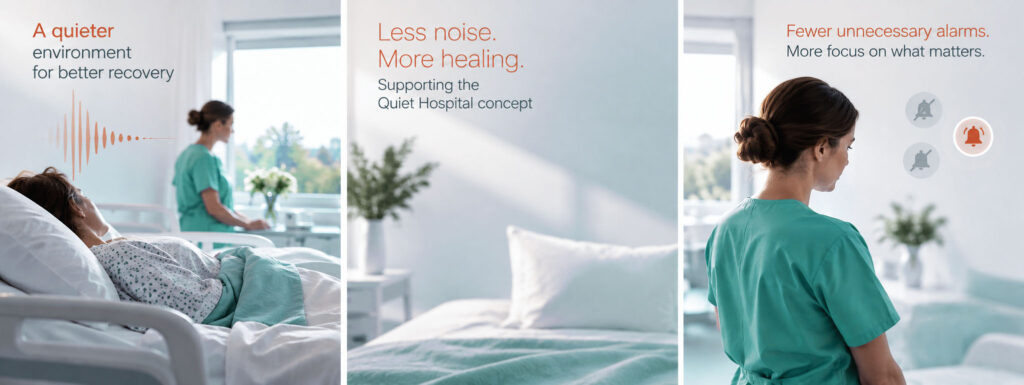
Introduction:
Hospitals are places of treatment and recovery, yet they are also environments filled with constant acoustic stimulation. Medical alarms, equipment, staff communication and technical systems can create sound levels significantly above those recommended for healing environments. The concept of the Quiet Hospital responds to this challenge by reducing unnecessary sources of noise and designing clinical environments in which technology supports care without adding avoidable acoustic burden. WarmQube naturally aligns with this philosophy. ts operating principle is designed not only around effective temperature management, but also around acoustic neutrality, alarm minimization and reduced disruption for patients and clinical staff.
Why hospital noise matters
Noise in healthcare environments is more than a question of comfort. Recommended hospital sound levels are typically far below those measured in real clinical environments, where alarms, medical devices, conversations and technical infrastructure can contribute to a persistent acoustic load. Excessive hospital noise has been associated with:
- sleep disruption and reduced quality of rest,
- increased stress and discomfort,
- impaired patient recovery,
- additional cognitive burden for healthcare professionals,
- communication difficulties,
- and potential patient-safety risks.
For patients, this can mean an environment that makes rest and recovery more difficult. For medical staff, it means operating in a setting in which clinically meaningful signals compete with a continuous stream of background sounds and notifications.
From noise reduction to better clinical environments
The Quiet Hospital concept is based on a simple principle: every unnecessary sound removed from the clinical environment creates more space for meaningful communication, rest and attention. Achieving this goal requires more than architectural solutions or behavioural initiatives. Medical technology itself plays an important role. A device designed for a modern hospital should not only perform its clinical function effectively. It should also minimize its impact on the surrounding environment. This is where WarmQube offers a distinctive advantage
Quiet by design
WarmQube is designed to minimize its acoustic footprint during normal operation. Rather than requiring additional noise-control measures, quiet operation is inherent in the way the system works.
Silent heating process
The WarmQube heating process is passive and silent. Unlike systems that rely on technologies such as:
- air blowers,
- fans,
- forced-air circulation,
- or continuously operating mechanical components,
WarmQube does not require these sources of operational noise. As a result, during standard use the system:
- does not generate continuous background noise,
- does not add unnecessary sound to the patient environment,
- and does not increase the acoustic load of the hospital ward.
The result is a technology that performs its function while remaining acoustically unobtrusive.
Fewer unnecessary audible alarms
Alarm fatigue has become an important issue in modern healthcare. Clinical environments can contain large numbers of audible notifications, many of which do not require immediate intervention. Studies have reported that a significant proportion of medical alarms may be non-actionable. Repeated exposure to alarms can contribute to:
- cognitive overload,
- reduced sensitivity to alerts,
- interruption of clinical tasks,
- stress among healthcare professionals,
- and increased risk that an important alarm is overlooked.
WarmQube is designed around a different philosophy. Audible alarms are limited to situations in which they are genuinely necessary. During normal operation, the device does not produce unnecessary sound notifications. This means WarmQube minimizes its contribution to the overall alarm environment and supports broader hospital strategies aimed at reducing alarm fatigue.
Supporting clinical focus
In a busy ward, every sound competes for attention. A device that continuously produces operational noise or repeated non-critical alerts adds another layer of stimulation to an already demanding clinical environment. By combining silent operation with a restrained alarm strategy, WarmQube can help reduce unnecessary acoustic and cognitive stimuli. For healthcare professionals, this supports an environment in which attention can remain focused on what matters most: the patient and clinically relevant information.
Supporting patient rest and comfort
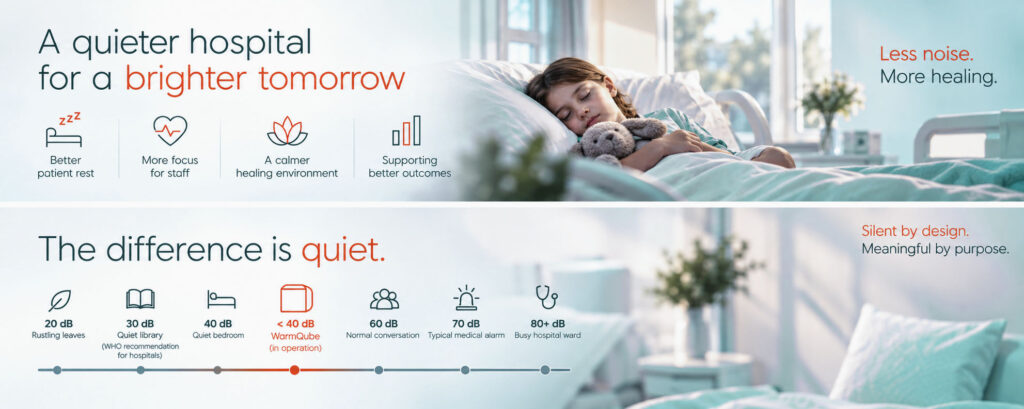
Rest is an important part of the healing process. For hospitalized patients, however, sleep can be repeatedly interrupted by equipment, alarms, conversations and background noise. A single silent device will not eliminate hospital noise entirely, but every source that can be removed contributes to a better acoustic environment. Because WarmQube does not generate continuous operational noise during the heating process, it avoids adding another constant sound source close to the patient. This can be particularly relevant in environments where patients remain exposed to medical technology for prolonged periods.
Quiet Hospital without additional infrastructure
Many hospital noise-reduction initiatives involve changes to buildings, room layouts, acoustic materials or workflow organization. These measures can be valuable, but they may also require additional investment and implementation effort. WarmQube approaches the problem at the device level. Its quiet operation is an inherent characteristic of the technology itself. This means healthcare facilities can gain the acoustic benefits of the system without installing additional noise-reduction infrastructure specifically for the device.
Two principles of Quiet Hospital. One technology.
WarmQube supports two fundamental principles of the Quiet Hospital concept.
I. Minimize unnecessary alarms. Audible alerts are restricted to situations where they are clinically or operationally important, reducing unnecessary contribution to the hospital alarm environment.
II. Eliminate operational noise where possible. The passive heating process requires no noisy blowers, fans or forced-air circulation, allowing WarmQube to operate without continuous background noise. Together, these features allow the system to provide its core functionality while remaining discreet within the clinical environment.
A quieter technology for a more healing environment
Modern healthcare technology should not only be effective. It should integrate naturally into the environment in which patients recover and clinicians work. WarmQube was designed with this principle in mind. By combining:
- passive and silent heating,
- absence of continuous mechanical noise,
- minimal use of audible alarms,
- and no unnecessary acoustic notifications,
WarmQube supports the development of a quieter, calmer and more focused hospital environment. It is not simply a device that happens to be quiet. Quiet operation is part of the way WarmQube is designed to work.
Benefits at a glance
For patients – Greater acoustic comfort and no additional continuous device noise in the immediate care environment. For healthcare professionals – Fewer unnecessary acoustic stimuli and reduced contribution to the overall alarm burden. For hospitals – Technology that supports Quiet Hospital initiatives without requiring dedicated acoustic infrastructure. For clinical environments – A device designed to perform its function without unnecessarily competing for attention.
WarmQube and the future of patient-centered technology
The hospital of the future will not be defined only by more advanced technology. It will also be defined by technology that understands its surroundings. Devices will increasingly need to communicate intelligently, operate discreetly and minimize unnecessary impact on patients and professionals. WarmQube represents this approach by combining its core heating functionality with a design philosophy based on quiet operation, selective alerting and environmental awareness. Because in a hospital, sometimes the best sound a medical device can make is no sound at all.
Scientific context
The principles described above are supported by research and guidance concerning hospital noise, sleep disturbance, healing environments and alarm fatigue, including publications and recommendations from the World Health Organization, research on environmental noise in hospitals, clinical sleep studies and alarm-management literature.
Suggested reference base:
- World Health Organization – Guidelines for Community Noise
- Research on environmental noise levels in hospital environments
- Clinical studies concerning hospital noise, sleep and patient recovery
- AAMI research and guidance concerning alarm management and alarm fatigue
- Literature concerning Quiet Hospital and healing-environment design
- Clinical safety research concerning alarm fatigue